With the Covid-19 shelter in place upon us, what better time to write some blogposts on my favorite movies? I do not have a favorite, that would be impossible. I have been able to narrow it down to a top 20, but even that is not a large enough list. And how do you categorize movies? Is it the best? Is it my favorite? Or is it a movie I just keep rewatching regardless of quality? All of the above? Probably.
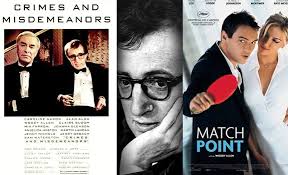
So I will just begin by writing a double feature of two of my favorites, both by Woody Allen. His 1989 “Crimes and Misdemeanors,” and his 2006 “Match Point.” I write about them together because in both movies, he is telling the same story, but in very different contexts.
Both films are a play on Dostoyevsky’s novel “Crime and Punishment,” the story of Raskolnikov, who commits two murders and lives with the mental and moral anguish until he confesses. Both of Allen’s films involve this same plot arc. In each, a married man, played by Martin Landau and Jonathan Rhys Meyers, is having an affair with another woman, played by Anjelica Huston and Scarlet Johansson. In each, he promises he will leave his wife, but he can’t. In each the lover gets impatient, and threatens to expose him. And in each… well, you know what happens.
Both Landau and Rhys Meyers live with the moral anguish of what they have done. They cover their tracks as best they can, but at every point, they fear they are going to be exposed. They live in incredible guilt. They almost confess to the police. But they never do. You think they are going to get exposed, but they don’t. Instead of the typical Hollywood ending where there is justice for the victim, there isn’t. The perpetrator gets away with it, and goes on to live his comfortable, wealthy life.
Other than this similar plot arc, the two films are very different. One takes place in New York, the other takes place in London. “Crimes” is filled with quirky comic relief (there is a great performance by an incredibly annoying Alan Alda), “Match Point” has none to speak of. But the most interesting difference is the moral universe in which both stories take place.
In “Crimes and Misdemeanors,” Martin Landau plays Judah Rosenthal, a wealthy, philanthropic Jewish ophthalmologist in New York. Judah lives in the moral universe of his Jewish upbringing. Judah himself notes the irony of his profession, since he constantly viewed his life as lived under the all-seeing eyes of God. His family debates the significance of the holocaust. He confesses his transgression to his Rabbi, who wisely advises him to “confess, seek forgiveness, and hope for the best.” He can’t. At the end, he is finally able to shake off the moral weight of his upbringing.
“Match Point,” on the other hand, has no such moral universe. It takes place in an empty universe, where everything happens through blind luck and chance. Rhys Meyers plays Chris Wilton, a former Tennis pro turned businessman, who sees life in terms of a tennis match. “There are moments in a match when the ball hits the top of the net, and for a split second, it can either go forward or fall back. With a little luck, it goes forward, and you win. Or maybe it doesn’t, and you lose.” In an extraordinary turn of events, just as Rhys Meyers is about to get caught by the police, the “ball hits the net and falls back” — but in this case he wins, and gets away with it.
And so comes true his philosophy of life: “The man who said “I’d rather be lucky than good” saw deeply into life. People are afraid to face how great a part of life is dependent on luck. It’s scary to think so much is out of one’s control.” Totally. By sheer luck, Chris Wilton, without any pangs of conscience, goes back to his life of ease.
Which film is more satisfying? Both. Both are incredibly well told. And neither. Whether you believe you live under the all seeing eye of God, or whether you believe it is better to be lucky than good, life usually never works out quite the way it does in either movie…




 Reflections. By RevBruce.